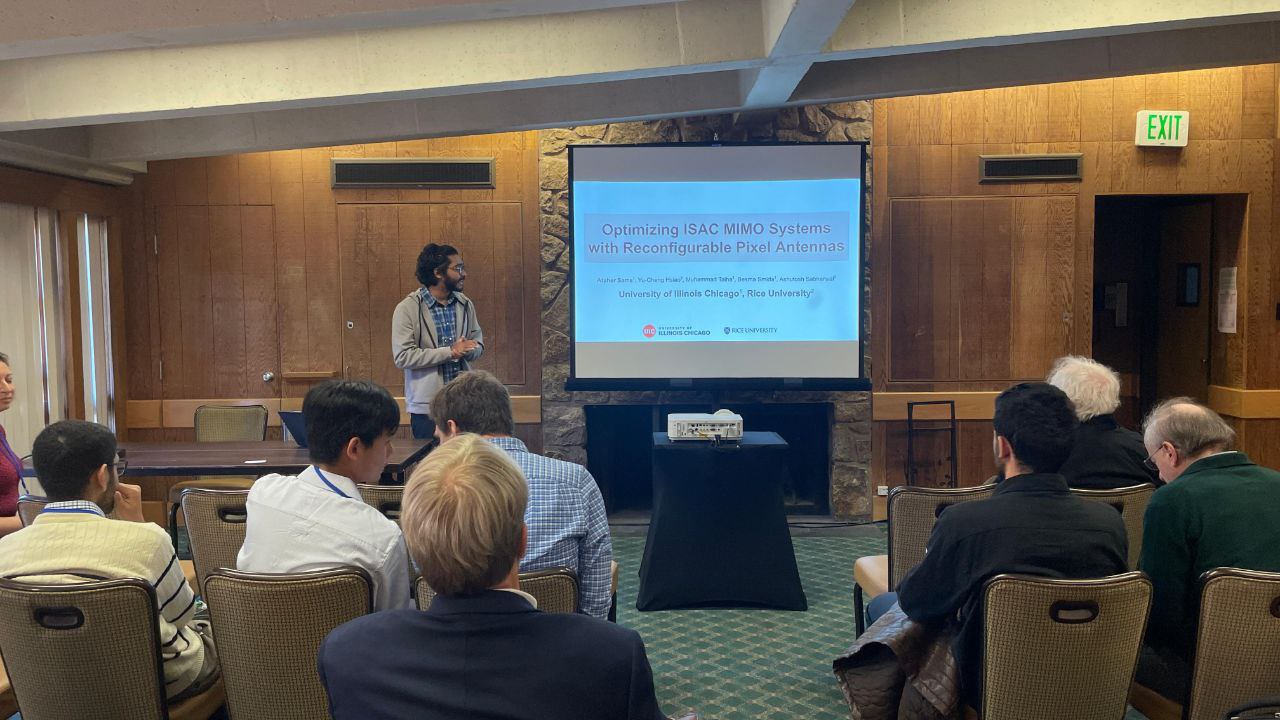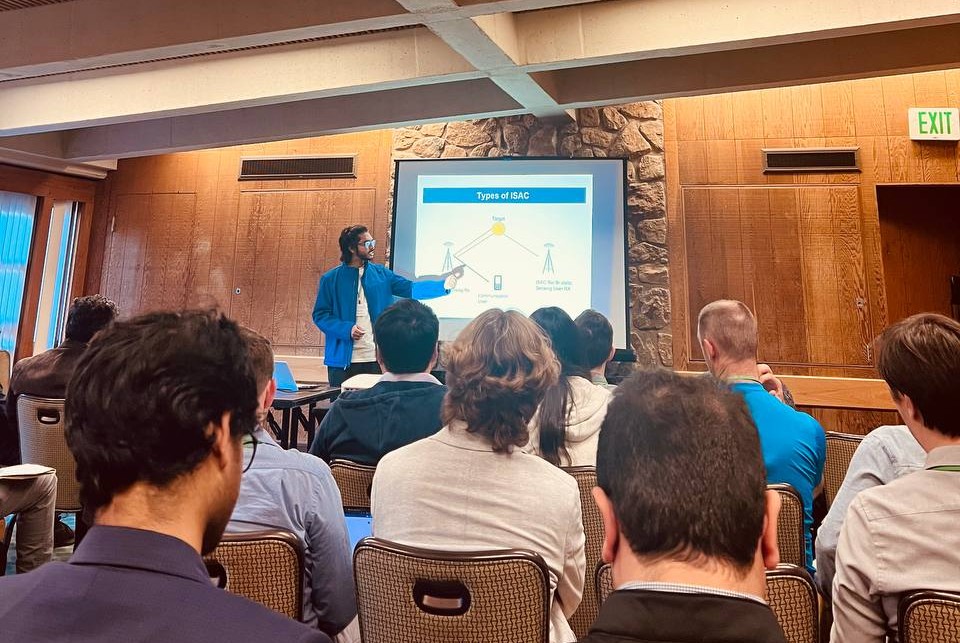
Integrated Sensing and Communication (ISAC)
In practical downlink networks, instantaneous channel state information at the transmitter is often unavailable and it is costly to acquire, frequently delayed, and unreliable in multi-user or multi-target scenarios. This forces ISAC systems to rely instead on statistical channel knowledge, raising a fundamental question: what are the theoretical limits of integrated sensing and communication when the transmitter operates without full Channel State Information? We characterize these limits through an information and estimation-theoric lens, while also addressing a key gap in sensing benchmarks: the classical Cramér-Rao bound is only reliable at high SNR and becomes unreliable in low-SNR regimes. To handle this, we explore the Ziv-Zakai bound for ISAC, which incorporates prior information and remains accurate across all SNR conditions.
Multi-Band System and Reconfigurable Antenna
Next-generation wireless systems increasingly operate across multiple, widely separated frequency bands — from sub-6 GHz through FR3 (7–24 GHz) and beyond. Across these bands, propagation loss, antenna aperture, and hardware behavior vary significantly, and the available spectrum is fragmented and often shared with incumbent services, making conventional single-band MIMO architectures ineffective. This project develops a generalized multi-band framework that exploits this frequency-partitioned structure rather than fighting it, using reconfigurable antenna architectures to adaptively reshape beam patterns and enable efficient joint sensing and communication across bands within a single hardware platform.
Deep Learning for Sensing
Classical subspace methods like MUSIC give robust direction-of-arrival estimates but break down at low SNR and with few snapshots. Rather than throwing data-hungry learning at the problem like recent literature, this project develops hybrid schemes whose decisions are grounded in the geometric structure of the signal subspace rather than learned purely from data. The aim is sample-efficient estimators that recover performance from very limited data while preserving the interpretability of classical methods.
Multiband Radar Sensing Fusion
A single radar band forces a compromise: 77 GHz buys fine range and angular resolution but degrades through occlusion and diffraction, while 24 GHz penetrates and bends around obstacles at the cost of resolution. This project aims to fuse the two: a 77 GHz TI radar and a 24 GHz tinyRad, into a single coherent sensing pipeline, using ultra-wideband coherent processing to treat the separated bands as one synthetic aperture in frequency.